Artificial intelligence is changing the way the world creates and consumes content. From automated news articles to AI-powered SEO writing, Press AI tools are becoming essential for publishers, bloggers, marketers, and media companies. In 2026, AI driven publishing platforms are helping businesses create high-quality content faster, improve audience engagement, and reduce production costs.
The term “Press AI” generally refers to artificial intelligence systems designed for journalism, media publishing, content generation, and digital communication. These tools combine machine learning, natural language processing, and automation to simplify content workflows and improve productivity.
Whether you run a blog, news website, marketing agency, or online business, understanding Press AI can give you a major competitive advantage.
What Is Press AI?
Press AI refers to AI-powered tools and platforms used for:
- Content writing
- News generation
- SEO optimization
- Media automation
- Social media publishing
- Content editing
- Audience analytics
These tools use advanced algorithms to analyze data, generate text, and automate repetitive publishing tasks.
Why Press AI Is Growing Rapidly
AI content tools have exploded in popularity because businesses need faster and more scalable ways to produce digital content.
Faster Content Creation
AI systems can generate:
- Blog posts
- Product descriptions
- News updates
- Marketing copy
- Social media captions
This saves publishers hours of manual work.
SEO Optimization
Modern Press AI platforms help writers optimize content for search engines by suggesting:
- Keywords
- Headings
- Meta descriptions
- Readability improvements
This is especially valuable for websites competing in high-CPC niches.
Lower Costs for Businesses
Companies can automate repetitive writing and editing tasks, reducing the need for large content teams.
How Press AI Works
Press AI platforms use technologies such as:
- Machine learning
- Natural language processing (NLP)
- Predictive analytics
- AI text generation
These systems analyze huge amounts of online content to generate human-like writing and identify trending topics.
Popular Uses of Press AI
AI publishing tools are now used across many industries.
News and Journalism
Media organizations use AI to generate:
- Financial reports
- Sports summaries
- Breaking news updates
- Weather reports
This allows journalists to focus on deeper investigative work.
Blogging and SEO
Bloggers use AI tools for:
- Article outlines
- Keyword research
- Long-form SEO content
- Content optimization
E-Commerce
Online stores use Press AI to create:
- Product descriptions
- Ad copy
- Email campaigns
- Customer support responses
Social Media Management
AI tools can automatically generate captions, hashtags, and posting schedules for social platforms.
Best Press AI Tools in 2026
Several AI platforms are leading the digital publishing industry.
1. ChatGPT
ChatGPT is widely used for article writing, brainstorming, SEO content, and conversational AI support.
Features
- Long-form content generation
- SEO-friendly writing
- AI research assistance
- Content summarization
2. Jasper AI
Jasper AI is popular among marketers and businesses for creating high-converting content.
3. Copy.ai
Copy.ai helps businesses automate social media posts, blogs, and marketing campaigns.
4. Grammarly AI
Grammarly uses AI to improve grammar, clarity, and writing quality.
Benefits of Using Press AI
Improved Productivity
Writers and publishers can create more content in less time.
Better SEO Performance
AI tools help optimize articles for search rankings and traffic growth.
Consistent Publishing
Businesses can maintain regular posting schedules without burnout.
Data-Driven Insights
Many Press AI tools analyze user behavior and engagement metrics to improve content strategies.
Challenges and Limitations of Press AI
Despite its advantages, AI publishing still has limitations.
Lack of Human Creativity
AI-generated content may sometimes feel repetitive or less emotionally engaging.
Fact-Checking Is Important
AI systems can occasionally produce inaccurate information, so human review remains essential.
SEO Risks
Overusing AI-generated content without originality or value can negatively impact search rankings.
Tips for Using Press AI Effectively
Combine AI With Human Editing
The best content usually combines AI speed with human creativity and expertise.
Focus on Quality
Search engines reward helpful, informative, and original content.
Use AI for Research and Structure
AI works best when assisting with:
- Topic ideas
- Keyword research
- Draft generation
- Content organization
Maintain Your Brand Voice
Customize AI-generated content to match your unique style and audience.
The Future of Press AI
The future of AI publishing looks incredibly promising. Experts predict major advancements in:
- Real-time content personalization
- AI video creation
- Voice-based publishing
- Multilingual content generation
- Predictive SEO analysis
AI tools may soon create highly personalized content experiences for every reader.
Is Press AI Replacing Human Writers?
Not entirely. While AI can automate repetitive tasks and speed up production, human creativity, storytelling, and emotional understanding are still extremely valuable.
The most successful publishers in 2026 are using AI as a tool—not a replacement—for professional writers and editors.
Conclusion
Press AI is transforming digital publishing by making content creation faster, smarter, and more efficient. From SEO blogging and journalism to e-commerce marketing and social media management, AI-powered tools are helping businesses grow online in competitive industries.
Promt
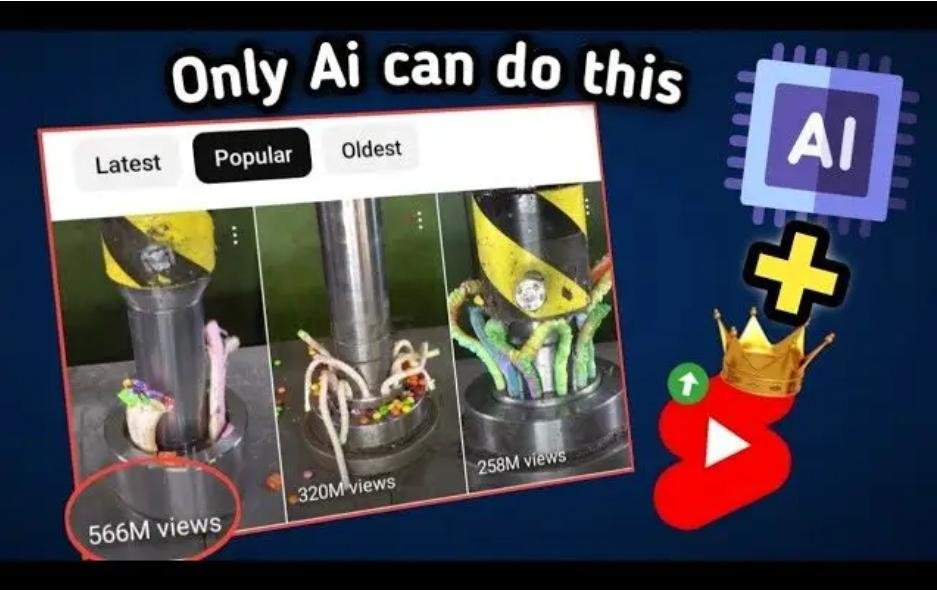
Create a hyper-realistic industrial video of a hydraulic press crushing a [OBJECT] in a real workshop environment.
The hydraulic press is a heavy-duty steel industrial machine with scratches, oil marks, and worn metal texture. It is placed on a concrete floor inside a small mechanical workshop. Lighting is natural fluorescent workshop lighting, slightly flat and realistic. No cinematic dramatic lighting.
A real [OBJECT] is placed exactly in the center between the top and bottom steel press plates.
The camera is fixed on a tripod, straight front angle, no cinematic movement. Real-time recording style. 30fps. 1080p. Documentary look.
The top hydraulic press plate slowly moves downward with steady, powerful force. The machine vibrates slightly. Mechanical humming sound is present.
The top and bottom press plates must remain perfectly aligned and parallel at all times.
The press continues descending without stopping until the top plate fully meets and firmly attaches to the bottom plate — like two solid metal blocks closing together completely, similar to hands clapping and fully touching.
The [OBJECT] in between must be completely crushed and compressed during this process.
No early stopping. No bouncing back. No explosion unless physically realistic. No flying debris unless the material naturally breaks. No exaggerated stretching.
The object must visibly deform under pressure according to real-world physics. It should compress, flatten, crack, bend, or collapse realistically depending on its material properties.
At the end of the video: The top and bottom plates are fully closed and touching each other. The [OBJECT] is fully crushed between them.
Sound design: real hydraulic press machine sound, metal creaking, compression noises. No music.
Style: Raw industrial experiment video. Authentic. Not cinematic. Not CGI-looking.
Negative prompt: No cartoon physics, no unrealistic deformation, no glowing effects, no dramatic explosions, no over-the-top slow motion, no unrealistic gaps between press plates.